HomeBisnisKOMINA Instructor Mode: Train Smarter, Not Harder

There’s a version of military training that has stayed essentially the same for a very long time.

An instructor designs a scenario. Personnel run the scenario. The instructor watches — sometimes from a good vantage point, sometimes not — takes mental notes, maybe jots some things down. The debrief happens afterward, and it’s necessarily incomplete. Human memory is imperfect. The instructor couldn’t be everywhere at once. The trainees remember what they remember, which correlates only loosely with what actually happened.

KOMINA’s Instructor Mode was designed to replace that process with something fundamentally better. And “better” here means more objective, more complete, and far more useful for actually improving performance.

What Instructors Can See — and Do — in Real Time

The first thing that surprises most instructors who engage with KOMINA for the first time is the level of situational awareness the platform provides.

In traditional field training, the instructor’s view is constrained by the same physics that constrain the trainees. You can position yourself on high ground. You can walk the perimeter. But there are walls you can’t see through, decisions being made in rooms you’re not in, and moments that happen too fast to catch.

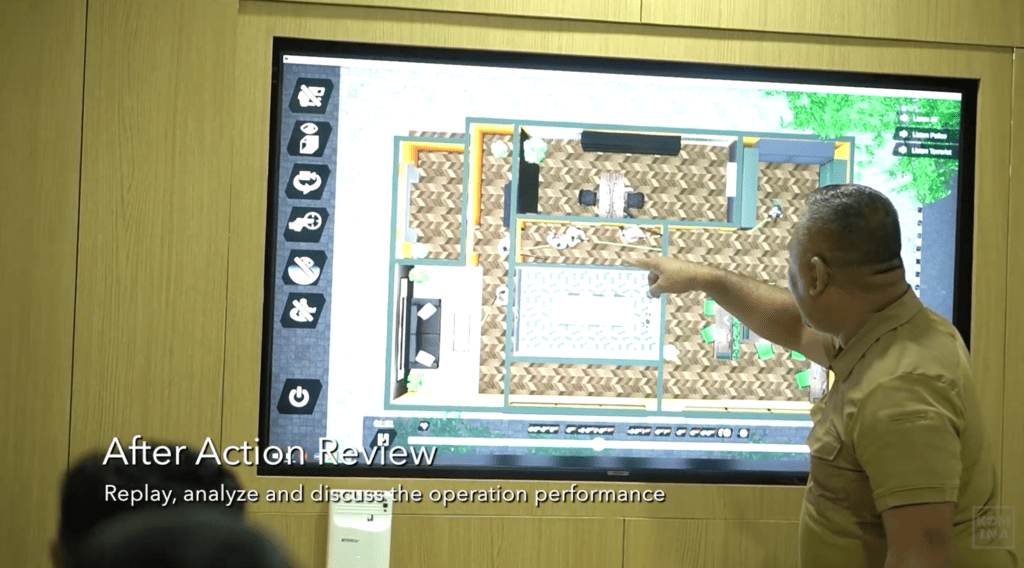
KOMINA’s top-down view gives instructors a bird’s-eye perspective of the entire training arena simultaneously. Every trainee’s position is visible in real time. Movement patterns, tactical decisions, positioning relative to threats — all of it is visible at once, from above.

The cone view shifts perspective to follow any individual trainee from their own first-person vantage point. An instructor who wants to understand exactly what a specific trainee saw at a critical moment, and what information they had available when they made a decision, can step into that perspective instantly.

Free roam mode allows the instructor to physically navigate the virtual environment — walk through walls, move through the arena, position themselves anywhere — for detailed inspection of specific areas or situations as they unfold.

And critically, the instructor can intervene in real time. Threat levels can be adjusted mid-scenario. New objectives can be introduced. Environmental conditions — lighting, weather, NPC behavior — can be changed on the fly. An instructor who wants to increase pressure on a team that’s managing a scenario too comfortably can do so immediately, without pausing the exercise.

This is a category of control that simply doesn’t exist in conventional training.

The Data That Changes Debrief Forever

If the Instructor Mode’s real-time capabilities are impressive, what happens after the session is where KOMINA’s analytical depth really becomes apparent.

Every KOMINA training session generates a comprehensive dataset. Shot accuracy and grouping patterns. Movement trajectory across the environment. Reaction time to threat identification. Time-to-decision across specific scenario branches. Tactical positioning relative to cover and threat vectors. Heart rate and stress data correlated against specific moments in the scenario.

This data isn’t just stored — it’s analyzed and visualized.

The after-action review system provides full 3D replay of the session from any angle and perspective. An instructor can rewind to a specific moment — say, the point at which a team’s communication broke down during a building clearance — and walk through it in detail, from any viewpoint, as many times as needed.

Performance metrics are tracked not just for individuals but for teams. Communication efficiency, coordination under pressure, tactical synchronization — all of it quantified and comparable against previous sessions.

Stress response curves show exactly how each trainee’s physiology tracked against the scenario’s intensity. This allows instructors to identify individuals who are performing well technically but showing physiological markers of unsustainable stress — a flag that’s nearly impossible to catch through observation alone.

What Good Data Actually Changes About Training

The shift from observation-based to data-driven training feedback isn’t just about having more information. It changes the nature of the conversation in debrief.

When a trainee pushes back on an assessment — “I was covering the doorway, I had good sight lines” — an instructor working from memory is in an argument. An instructor working with KOMINA’s replay data can simply show them, from any perspective, what the actual sight lines were. The conversation moves from “my word against yours” to “here’s what happened — now let’s figure out why.”

This changes the psychology of feedback, too. Trainees who might be defensive about criticism based on an instructor’s subjective assessment are typically far more receptive when they’re looking at their own data. It’s harder to argue with your own reaction time curve.

The progress tracking dimension adds another layer. Individual and team improvement across multiple sessions is visible as a trend, not just a snapshot. Instructors can see exactly where improvement is happening, where it has plateaued, and which specific scenarios or skill areas need additional focus.

The Scale Advantage

One of the underappreciated benefits of data-driven virtual training for military and law enforcement is what it enables at scale.

A single KOMINA installation can run multiple trainees simultaneously, with one instructor monitoring all of them through the platform’s multi-perspective view. The data captured from each session feeds into longitudinal records that track readiness across an entire unit over time.

This creates something traditional training rarely achieves: a continuously updated, objective picture of a unit’s collective capability profile. Where are they strong? Where are the gaps? Which specific scenarios is the team executing well, and which are they struggling with? What’s the trend line over the past six months?

These are questions that defense organization leadership has always wanted answered. KOMINA is one of the first platforms that actually answers them.

See how KOMINA’s Instructor Mode works in practice at https://komina.co/
There’s a version of military training that has stayed essentially the same for a very long time.

An instructor designs a scenario. Personnel run the scenario. The instructor watches — sometimes from a good vantage point, sometimes not — takes mental notes, maybe jots some things down. The debrief happens afterward, and it’s necessarily incomplete. Human memory is imperfect. The instructor couldn’t be everywhere at once. The trainees remember what they remember, which correlates only loosely with what actually happened.

KOMINA’s Instructor Mode was designed to replace that process with something fundamentally better. And “better” here means more objective, more complete, and far more useful for actually improving performance.

What Instructors Can See — and Do — in Real Time

The first thing that surprises most instructors who engage with KOMINA for the first time is the level of situational awareness the platform provides.

In traditional field training, the instructor’s view is constrained by the same physics that constrain the trainees. You can position yourself on high ground. You can walk the perimeter. But there are walls you can’t see through, decisions being made in rooms you’re not in, and moments that happen too fast to catch.

KOMINA’s top-down view gives instructors a bird’s-eye perspective of the entire training arena simultaneously. Every trainee’s position is visible in real time. Movement patterns, tactical decisions, positioning relative to threats — all of it is visible at once, from above.

The cone view shifts perspective to follow any individual trainee from their own first-person vantage point. An instructor who wants to understand exactly what a specific trainee saw at a critical moment, and what information they had available when they made a decision, can step into that perspective instantly.

Free roam mode allows the instructor to physically navigate the virtual environment — walk through walls, move through the arena, position themselves anywhere — for detailed inspection of specific areas or situations as they unfold.

And critically, the instructor can intervene in real time. Threat levels can be adjusted mid-scenario. New objectives can be introduced. Environmental conditions — lighting, weather, NPC behavior — can be changed on the fly. An instructor who wants to increase pressure on a team that’s managing a scenario too comfortably can do so immediately, without pausing the exercise.

This is a category of control that simply doesn’t exist in conventional training.

The Data That Changes Debrief Forever

If the Instructor Mode’s real-time capabilities are impressive, what happens after the session is where KOMINA’s analytical depth really becomes apparent.

Every KOMINA training session generates a comprehensive dataset. Shot accuracy and grouping patterns. Movement trajectory across the environment. Reaction time to threat identification. Time-to-decision across specific scenario branches. Tactical positioning relative to cover and threat vectors. Heart rate and stress data correlated against specific moments in the scenario.

This data isn’t just stored — it’s analyzed and visualized.

The after-action review system provides full 3D replay of the session from any angle and perspective. An instructor can rewind to a specific moment — say, the point at which a team’s communication broke down during a building clearance — and walk through it in detail, from any viewpoint, as many times as needed.

Performance metrics are tracked not just for individuals but for teams. Communication efficiency, coordination under pressure, tactical synchronization — all of it quantified and comparable against previous sessions.

Stress response curves show exactly how each trainee’s physiology tracked against the scenario’s intensity. This allows instructors to identify individuals who are performing well technically but showing physiological markers of unsustainable stress — a flag that’s nearly impossible to catch through observation alone.

What Good Data Actually Changes About Training

The shift from observation-based to data-driven training feedback isn’t just about having more information. It changes the nature of the conversation in debrief.

When a trainee pushes back on an assessment — “I was covering the doorway, I had good sight lines” — an instructor working from memory is in an argument. An instructor working with KOMINA’s replay data can simply show them, from any perspective, what the actual sight lines were. The conversation moves from “my word against yours” to “here’s what happened — now let’s figure out why.”

This changes the psychology of feedback, too. Trainees who might be defensive about criticism based on an instructor’s subjective assessment are typically far more receptive when they’re looking at their own data. It’s harder to argue with your own reaction time curve.

The progress tracking dimension adds another layer. Individual and team improvement across multiple sessions is visible as a trend, not just a snapshot. Instructors can see exactly where improvement is happening, where it has plateaued, and which specific scenarios or skill areas need additional focus.

The Scale Advantage

One of the underappreciated benefits of data-driven virtual training for military and law enforcement is what it enables at scale.

A single KOMINA installation can run multiple trainees simultaneously, with one instructor monitoring all of them through the platform’s multi-perspective view. The data captured from each session feeds into longitudinal records that track readiness across an entire unit over time.

This creates something traditional training rarely achieves: a continuously updated, objective picture of a unit’s collective capability profile. Where are they strong? Where are the gaps? Which specific scenarios is the team executing well, and which are they struggling with? What’s the trend line over the past six months?

These are questions that defense organization leadership has always wanted answered. KOMINA is one of the first platforms that actually answers them.

See how KOMINA’s Instructor Mode works in practice at https://komina.co/
Related Post

Scroll to Top