When people think about danger at height, they think about the worker falling. But a worker isn’t the only thing that can drop. A dropped tool from a few storeys up carries enough force to seriously injure or kill someone below, and the everyday discipline that prevents it — securing tools, managing footing, keeping the work area controlled — is exactly the kind of routine habit that erodes the more comfortable a worker gets. VR safety training for work at height can drill these unglamorous habits the same way it drills harness discipline.
The hazard below the worker
Height safety understandably fixates on fall protection, and Indonesia’s Permenaker 9/2016 framework rightly demands it. But working at height creates a second danger zone — the ground beneath. A spanner, a bolt, an unsecured offcut: any of them becomes a deadly projectile if it slips from a working hand or an uncontrolled edge. The people most at risk often aren’t the ones at height at all; they’re the ones walking below, who never agreed to the risk and can’t see it coming.
The habits that prevent this are mundane and therefore easily neglected: tethering tools, never overreaching, keeping the platform clear of loose items, maintaining three points of contact so a slip doesn’t send both the worker and their tools down. Because nothing usually falls, workers stop thinking about it — until something does.
What VR can rehearse
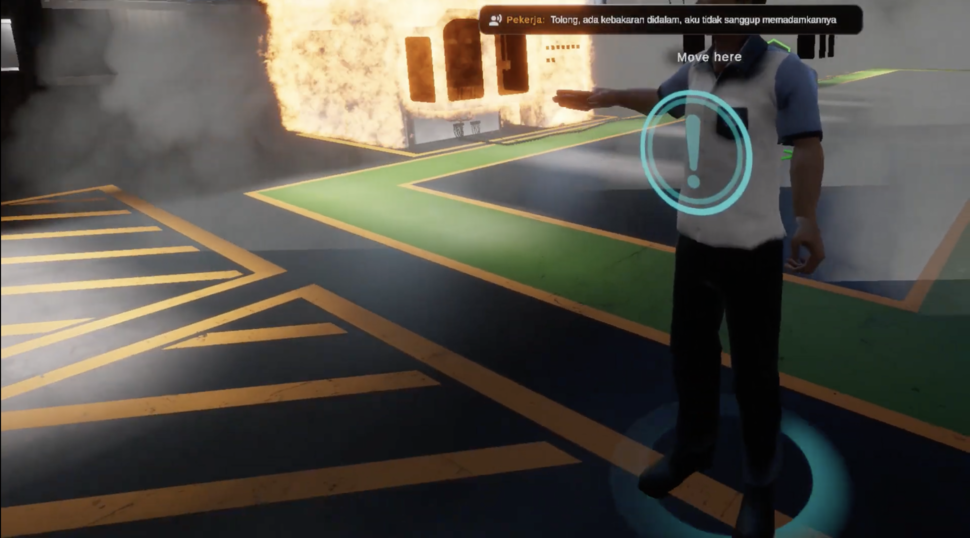
A VR work-at-height scenario can build these dangers in: a tool left unsecured near an edge, an overreach that costs balance, a cluttered platform. The worker practises the discipline of securing tools and controlling their work area, and sees the consequence — for themselves and for the people below — when they don’t.
Indonesian developer VGLANT builds height scenarios on consequence-based learning, which suits this perfectly: a worker who knocks an unsecured tool off a virtual platform and watches where it lands understands, viscerally, why tethering and a tidy work area matter. The lesson lands without anyone below paying for it. That felt consequence is what turns “secure your tools” from a poster into a habit.
Footing and overreach
There’s a related discipline VR drills well: managing your own movement at height. Most slips at height come from overreaching, rushing, or losing a point of contact — small lapses that feel harmless until one ends in a fall or a dropped load. Rehearsing careful, deliberate movement in convincing simulated height builds the bodily discipline of not overextending, of moving methodically, of keeping control. That composure protects both the worker and everyone beneath them.
The honest limit
VR doesn’t replace hands-on practice with real tethering equipment or the physical reality of handling tools at height. The tactile habits have to be built for real too. VR builds the awareness, the discipline, and the instinct to control the work area; it complements physical training rather than replacing it.
But it fixes a blind spot that fall-focused training routinely leaves: the danger a worker at height poses to everyone below. By drilling tool discipline and controlled movement until they’re automatic, VR helps ensure the only thing that ever comes down from a height is the worker, safely, at the end of the job.
At height, the worker is one hazard. Everything in their hands is another. VR trains the discipline that keeps both from falling.