Mining companies use digital technology in two related areas: monitoring operations and training personnel. Digital twins mainly support the first. Virtual reality (VR) training mainly supports the second. Both rely on accurate 3D representations of equipment and environments. This article explains how each applies to heavy equipment in mining and where they connect.
The Training Challenge for Heavy Equipment
Large mining vehicles, such as haul trucks and excavators, weigh tens of tonnes and are expensive to operate. New operators need to learn the machine before they begin working on site. Training on real equipment has limits:
- the machine is taken out of production during training
- mistakes can damage equipment or create safety risks
- the number of practice hours is limited by equipment availability
VR training provides a way to start learning before entering the real cabin.
VR training uses a headset to place the trainee in a 3D environment. Virtu’s XR and Industry 4.0 page describes VR as fully immersive, with six-degrees-of-freedom tracking that lets users move within the virtual environment. This allows trainees to walk around a virtual vehicle and interact with its parts.
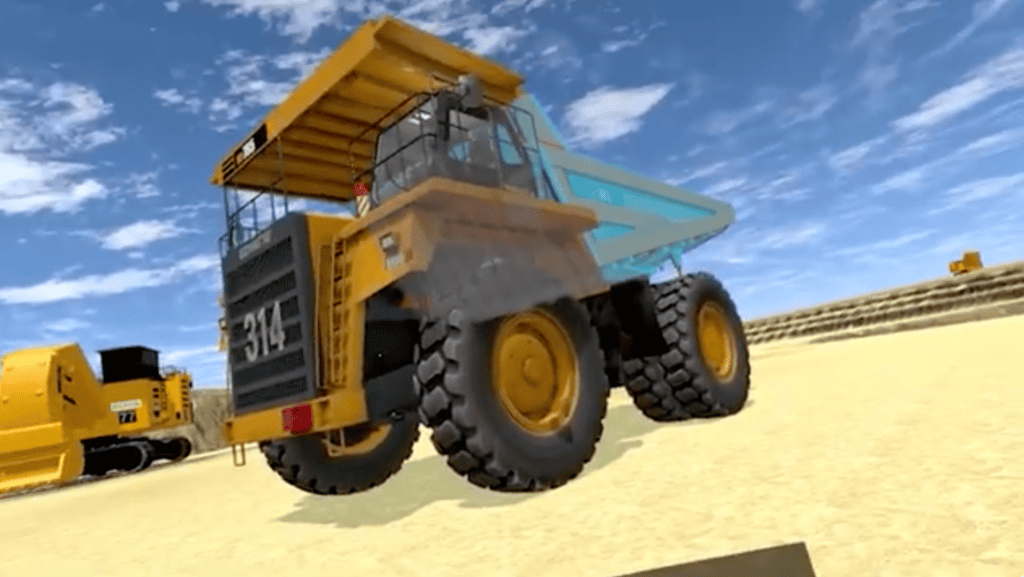
Virtu’s Heavy Duty Mining Vehicles VR Training
Virtu has developed VR training for heavy duty mining vehicles. According to its project page, the training is intended to familiarise new operators with the vehicle before they enter the cabin. It is organised in four stages:
- Components. Trainees learn the major parts of the vehicle.
- Inspection. Trainees walk around the unit and examine parts relevant to maintenance.
- Cabin. Trainees learn the function of the buttons, levers and displays.
- Simulations. Trainees practise common work tasks.
Virtu’s page notes that starting such a vehicle involves more steps than turning an ignition key, and the training covers these procedures. A back-end dashboard records results, allowing supervisors to assess each trainee’s progress.
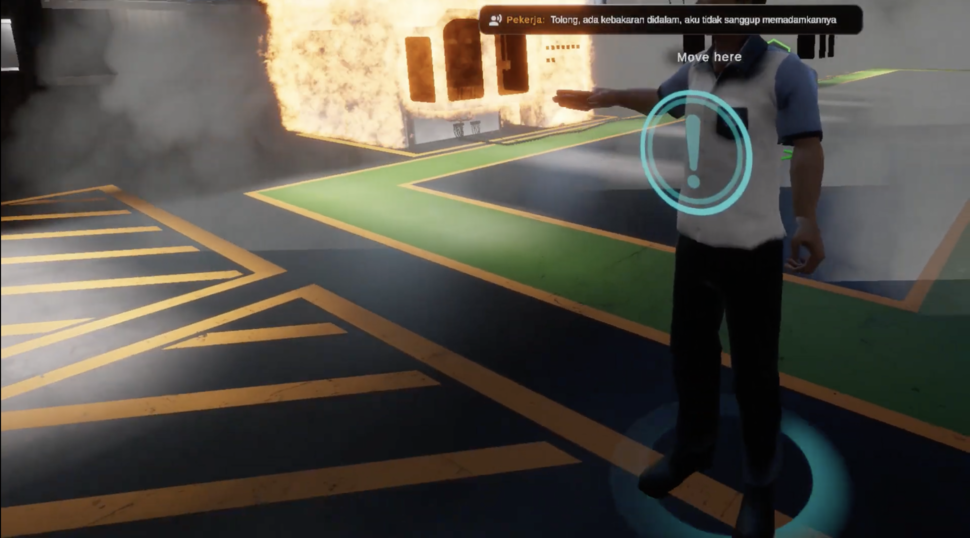
Virtu also lists a BUMA Coal Mining Supervisor VR Training project, described as simulating important and high-risk mining situations in a safe and repeatable way.
Features of VR Training
Virtu’s VR training page lists several features:
- Targeted scenarios that recreate rare or difficult events
- Precise tracking of trainee actions for assessment
- Portability, allowing training in different locations
- Customised environments that match a client’s actual conditions
The page also describes iterative assessment, where feedback is given during training rather than only at the end.
Where Digital Twins and VR Training Connect
Digital twins and VR training are separate tools, but they can share resources.
3D models. Equipment and terrain models created for one can support the other. A detailed 3D model of a haul truck used in training can also represent that truck in a digital twin.
Site environments. Terrain data captured for a digital twin, for example through drone LiDAR, can be used to create training environments that resemble the actual site. Virtu’s VR training page lists customised environments that match the client’s conditions as a feature.
Operational insight. Patterns seen in a digital twin, such as road sections with low speeds or frequent congestion, can help training teams decide which situations to include in training scenarios.
Measuring Training Results
VR training produces records of what each trainee did. Virtu’s heavy equipment training includes a dashboard for supervisors to review progress. These records help identify which steps trainees find difficult, such as specific inspection points or start-up procedures.
VR Training Does Not Replace Practical Training
VR training prepares operators before they use real equipment. It does not replace supervised practical training, site induction or competency assessment on the actual machine. Its role is to make the transition to real equipment safer and more efficient.
Planning a Training Program
Mining companies considering VR training for heavy equipment should define:
- which equipment types and procedures to include
- the stages trainees must complete before practical training
- how results will be assessed and recorded
- how VR training fits with existing induction and certification
Summary
Digital twins and VR training both use 3D representations of mining equipment and sites. Digital twins support operations, while VR training prepares operators. Shared models and data can support both. Mining companies interested in either solution can contact Virtu to discuss their training and operational needs.